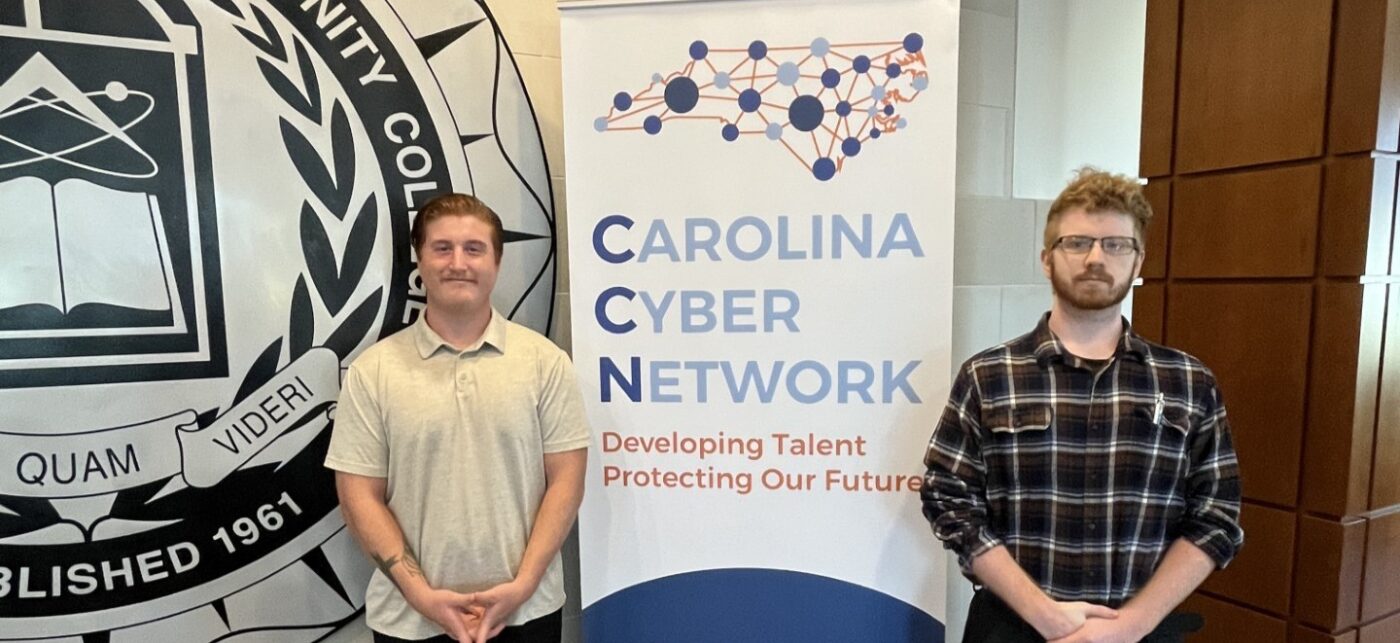
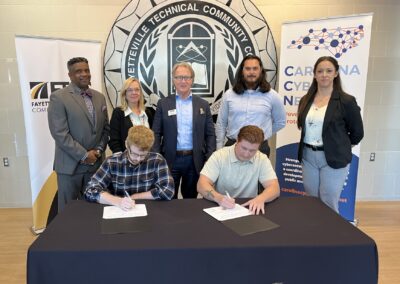
Samuel Abling, seated at left, and Jacob Wright sign certificates at a ceremony celebrating their internships with the NC Department of Information Technology at FTCC on Nov. 3, 2025. FTCC Dean of Information Technology Dwayne Campbell, Senior VP of Academic Services Dr. Murtis Worth, President Dr. Mark Sorrells, Carolina Cyber Network Intern Program Manager Marcus Holley and Cybersecurity Department Chair Rhiannon Holley stand behind them.
Fayetteville Technical Community College and Carolina Cyber Network held a ceremonial signing Monday for students who have been selected for internships with the NC Department of Information Technology.
FTCC students Samuel Abling, Jacob Wright and Megan Harris began their internships with NCDIT at the end of October.
Abling and Wright, who are both in their second year of FTCC’s Systems Security and Analysis program, put pen to paper Monday to celebrate their achievement. Harris is an alumna of the same program.
“We know you’re going to make us proud because we know you put in the work, you put in the effort and you’re prepared to go up there and do a great job,” FTCC President Dr. Mark Sorrells said.
The FTCC trio make up one-third of the first cohort of interns through a new partnership between NCDIT and Carolina Cyber Network. The initiative, which creates a pipeline of interns educated at institutions in CCN’s 23-member collaborative, is designed to strengthen the state’s cybersecurity landscape and provide valuable experience to emerging talent in the workforce.
NCDIT Secretary and State Chief Information Officer Teena Piccione announced the internship program at FTCC this summer, with the college tabbed to provide the first interns for the initiative.
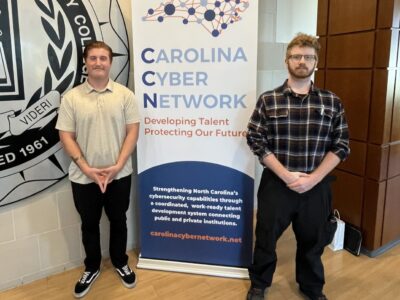
FTCC students Jacob Wright and Samuel Abling have started internships with the NC Department of Information Technology.
“Cybersecurity is one of our state’s top priorities, and the Carolina Cyber Network is an outstanding partner in our efforts to nurture cyber talent and strengthen our cyberdefense capabilities,” Piccione said then. “We’re excited to establish this new program that will help us stay ahead of the rapidly evolving threat landscape while supporting important career pathways.”
The interns each work up to 25 hours per week remotely for the state agency for one year. That experience could lead to securing an apprenticeship with the NCDIT.